Future Rail System
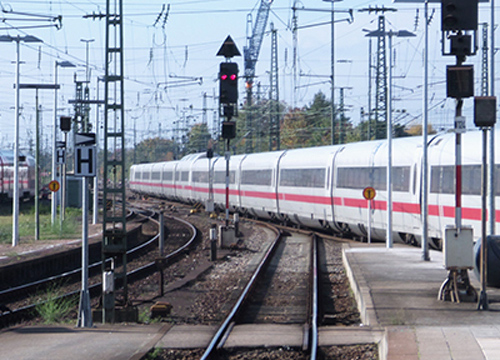
The environmentally friendly rail transport mode and the objective of modal shift from road to rail have been part of political rhetoric for many years. However, the condition of the German rail network has deteriorated to such an extent that, for example, in long-distance passenger transport, trains currently achieve a punctuality rate of only around 60%, with cancelled trains not even included in this indicator.
In rail freight transport, the so-called single wagonload traffic can only continue to operate with the support of dedicated subsidy programs, while demand in bulk and heavy goods transport, typically handled via profitable full block trains, is declining. DB Cargo now operates less than 50% of freight services on the German rail network but must demonstrate financial self-sufficiency from 2026 on in accordance with European regulatory requirements.
M-Five has been analysing the admittedly challenging development of the rail sector for many years using a wide range of scientific approaches:
The basis are rail transport demand forecasts calculated by the inhouse system dynamics model ASTRA. This model calculates current and future annual states including various sectors of the economy, such as population, economy, energy, and vehicle fleets. Within this framework, policy measures and wild card developments in individual sectors can be implemented, simulated, and evaluated. Among other applications, this model has also been used in the annual greenhouse gas reporting 2025/2026 by the German Environment Agency (UBA), (Projektion 2026).
Using these forecasts, M-Five has developed estimates for the National Platform Future of Mobility (NPM) and the Expert Council on Climate-Friendly Mobility (EKM) regarding the maximum contribution of rail to achieving climate targets across different time horizons. Objectives include both the electrification of rail operations and the modal shift of transport demand from road to rail. A wide range of instruments were considered, such as track access charge subsidies, support for different operating modes of freight transport, the impacts of the Deutschlandticket, as well as interactions with the electrification of road transport.
A recovery of the rail sector and its operations requires adequate financial resources. In the context of establishing the special fund for infrastructure and climate neutrality, we have estimated the investment requirements for rail – covering maintenance, new construction and expansion, as well as the rollout of new systems for operational control (ETCS) through to 2050. We also analysed different investment strategies (e.g., maintenance before expansion).
In addition, M-Five’s rail portfolio includes evaluation methodologies, such as those used in the Federal Transport Infrastructure Plan (FTIP) for the rail sector. Further, transport market studies for two of the European Rail Freight Corridors (RFC) have been developed: Atlantic Corridor from Mannheim to Lisbon, and former Rhine-Alpine Corridor from Rotterdam to Genua. On behalf of the European Commission, we supported the development of the Trans-European Transport Network (TEN-T). Here M-Five carried out the impact assessment for the revision of Union guidelines for the development of the TEN-T and supported the development of workplans of the Atlantic Corridor since 2016.